
Quick Answer: Airline technical interviews follow predictable patterns. The same core topics — stall, V-speeds, weather minima, CRM, engine failure on takeoff, alternate fuel requirements — appear at virtually every EASA carrier. This guide gives you the 10 questions most likely to come up, explains what the panel is actually testing, and provides a model answer you can adapt to your own voice.
What the Technical Interview Is Really Testing
Before we get to the questions, it's worth being clear about what's actually happening in a technical interview — because most candidates misunderstand it.
The panel is not trying to catch you out. They are not expecting textbook-perfect recitations of ATPL theory. What they want to see is whether you think like a pilot.
Specifically, they're evaluating three things:
- Conceptual understanding. Can you explain why something happens, not just what the rulebook says?
- Operational relevance. Can you connect theory to real-world flying decisions?
- Communication under pressure. Can you stay structured and clear when you're nervous and being watched?
A candidate who says "the stall occurs when the critical angle of attack is exceeded" and stops there has given a correct but weak answer. A candidate who continues — explaining what the pilots feel, how the aircraft reacts, what the recovery looks like, and why modern airliners have protections against it — has demonstrated pilot thinking.
Keep that in mind as you read each model answer below. The goal isn't to memorise the words. It's to understand the structure of what a strong answer looks like.
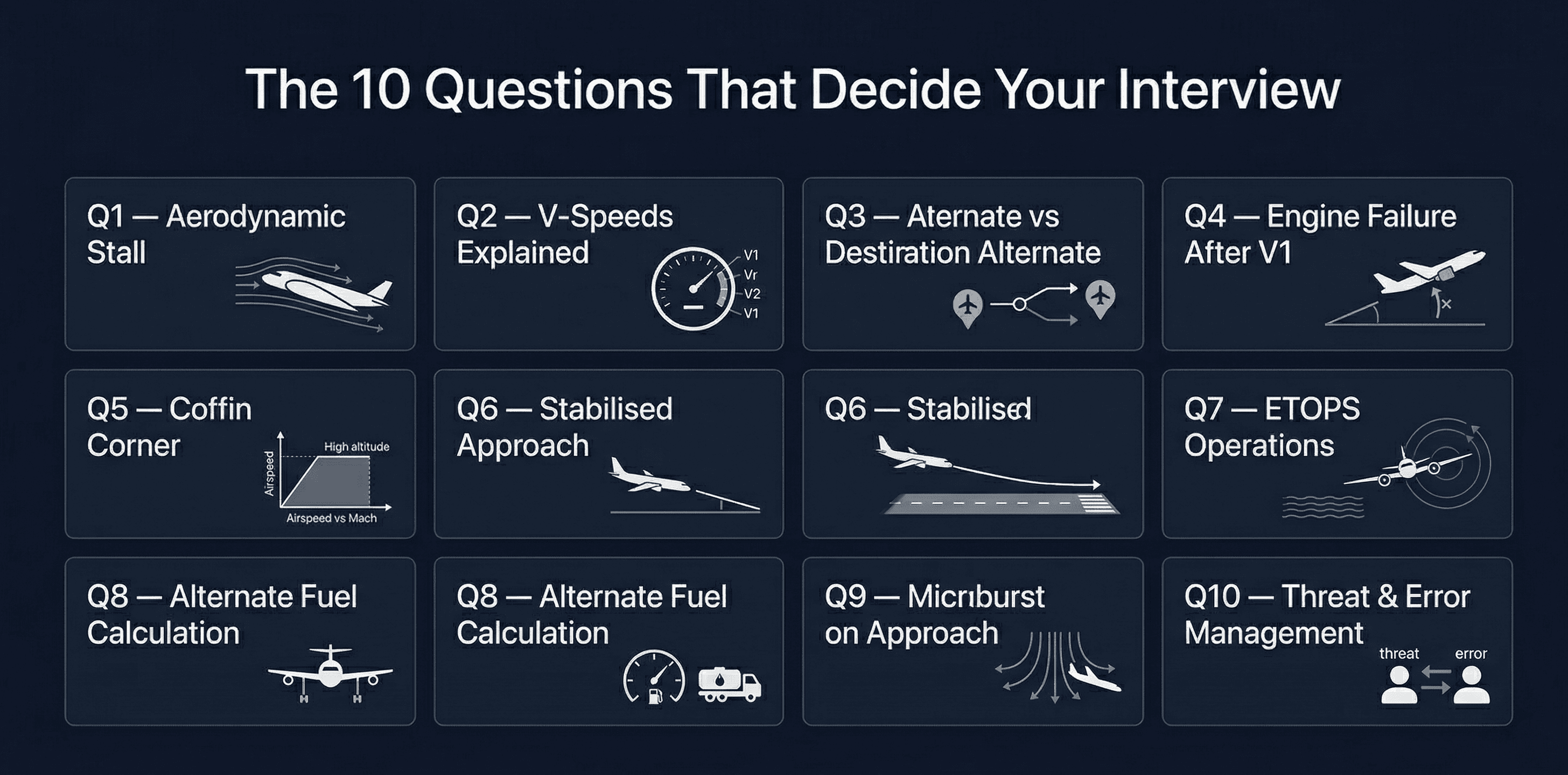
The 10 Questions
Q1 — Walk me through what happens aerodynamically in a stall.
Why they ask it: The stall is fundamental. It tests whether the candidate truly understands lift generation and angle of attack — not just that stalls happen, but the precise physical mechanism.
Model answer:
A stall occurs when the wing exceeds its critical angle of attack — typically around 15–18 degrees for most commercial aircraft. At that point, the airflow over the upper surface of the wing separates and becomes turbulent rather than remaining attached. Lift drops sharply and drag increases dramatically.
It's important to note that a stall is entirely independent of airspeed — you can stall at any speed, any attitude, and any power setting. The only variable that matters is angle of attack.
In a modern airliner, the pilot will typically feel buffet before the full stall as turbulent air from the wing root reaches the tailplane. The stick shaker activates as an additional warning. Recovery involves reducing angle of attack — pushing forward on the controls — applying full thrust, and minimising bank angle to maximise the wing's contribution to lift. Height permitting, the priority is to recover flight path before attempting to arrest any altitude loss.
Why this works: It covers the mechanism (angle of attack, flow separation), the common misconception (stall ≠ low speed), the indications in a modern jet (buffet, stick shaker), and the recovery sequence. It demonstrates both ATPL knowledge and operational thinking.
Q2 — What are the V-speeds and why do they matter?
Why they ask it: V-speeds are bread-and-butter airline knowledge. The panel wants to confirm you know the definitions precisely and can explain their operational significance — not just recite letters.
Model answer:
The critical V-speeds for takeoff performance are:
V1 — the decision speed. At V1, the pilot must be committed to the takeoff. If an engine fails before V1, we stop. If the failure occurs at or after V1, we continue the takeoff — because the runway remaining is insufficient for a safe stop and the aircraft is certified to fly on the remaining thrust.
VR — rotation speed. The point at which the pilot applies back pressure to raise the nose and initiate the takeoff attitude. Rotating before VR risks a tail strike; rotating late extends the ground roll.
V2 — takeoff safety speed. The minimum speed at which the aircraft meets its climb gradient requirements with one engine inoperative. We target V2+10 in the initial climb after an engine failure to provide a margin above minimum.
These speeds are not fixed — they are calculated for every departure based on aircraft weight, flap setting, pressure altitude, temperature, and runway condition. That calculation is what performance is all about.
Why this works: It defines each speed accurately, explains the decision logic behind V1 (not just the definition), clarifies that V2 is a minimum not a target, and connects all three to the performance calculation — showing the candidate understands the system, not just the acronyms.
Q3 — Explain the difference between alternate and destination alternate.
Why they ask it: Fuel and alternate planning is a core operational skill. Many candidates blur the definitions. The panel wants precision.
Model answer:
A destination alternate is an aerodrome filed in the flight plan to which the aircraft can divert if the destination becomes unusable — due to weather, airport closure, or any other reason. Under EASA regulations, a destination alternate is required unless certain conditions are met: the flight is 6 hours or less to destination and two separate runways are available and the forecast weather is above prescribed minima for a defined period around ETA.
An ERA — en-route alternate — is different. It is an aerodrome along the route, identified for use in the event of a significant degradation of the aircraft's capability in flight — such as a pressurisation failure or engine shutdown — that makes continuing to destination impractical or unsafe.
The fuel implications are significant. Alternate fuel is calculated for the missed approach at destination, then a climb to cruise altitude, cruise to the alternate, a descent and approach. This is in addition to trip fuel, contingency fuel, and final reserve. Getting these categories right is the difference between a legal fuel load and a compliance failure.
Why this works: It distinguishes clearly between the two concepts, states the EASA conditions under which a destination alternate is not required, introduces ERA as a related concept, and connects the definition to the fuel planning implications — showing practical operational understanding.
Q4 — What would you do in the event of an engine failure after V1?
Why they ask it: This is a non-normal procedure question. The panel wants to see disciplined, prioritised thinking — not panic, and not an exhaustive systems recitation.
Model answer:
After V1, the decision is made: we fly. The first priority is always aviate — maintain control of the aircraft. With an engine failure at or after V1, the aircraft will yaw toward the failed engine due to asymmetric thrust. The pilot flying corrects with rudder to keep the aircraft tracking the runway centreline and continues the rotation at VR.
After lift-off, the priority is to establish a positive rate of climb and retract the gear to reduce drag. We accelerate toward V2, or maintain V2 if already there, and fly the engine failure procedure as briefed — which means following the SID or the engine failure contingency route as applicable.
The 'dead, dark, dirty' flow helps: the dead engine is identified, then confirmed dead by cross-checking instruments, then the appropriate checklist is actioned. We do not rush the diagnosis. The aircraft is flying and controllable — the checklist can wait until we are established in a safe climb.
ATC is informed, the crew is coordinated, and we plan for a return or diversion as appropriate, with the captain making the decision based on fuel, weather, and the nature of the failure.
Why this works: It uses the aviate-navigate-communicate priority framework, correctly identifies yaw as the first handling challenge, explains the 'dead, dark, dirty' logic for engine identification, and emphasises crew coordination and disciplined checklist use — all qualities the panel is specifically looking for.
Q5 — What is coffin corner and when does it become relevant?
Why they ask it: Coffin corner tests high-altitude aerodynamic understanding. It separates candidates who genuinely understand performance from those who memorised a textbook.
Model answer:
Coffin corner describes the narrow flight envelope that exists at very high altitudes, where the low-speed stall buffet speed and the high-speed Mach buffet speed converge.
At altitude, as air density decreases, the indicated airspeed at which the wing stalls remains roughly constant in terms of angle of attack — but the true airspeed increases significantly. Simultaneously, the Mach number at which compressibility effects cause high-speed buffet decreases as temperature drops. These two limits approach each other as you climb higher.
At the aircraft's absolute ceiling, the two buffet boundaries may be separated by only a few knots of indicated airspeed. A small increase in angle of bank in a turn — which effectively increases load factor and therefore stall speed — can push the aircraft into low-speed buffet. A small increase in speed can trigger high-speed buffet from the Mach side.
In practice, modern jets are operated well below their absolute ceiling. But understanding coffin corner explains why high-altitude step climbs require careful weight consideration, and why turbulence at cruise altitude can be genuinely hazardous — reducing the already narrow margins further.
Why this works: It explains the mechanism from both sides (low-speed and high-speed), identifies load factor in turns as a practical trigger, and connects the concept to real operational implications — step climbs and turbulence handling.
Q6 — Explain the stabilised approach criteria.
Why they ask it: Unstabilised approaches are one of the leading contributors to approach-and-landing accidents. The panel wants to confirm you know the criteria precisely and take them seriously.
Model answer:
A stabilised approach means that by 1,000 feet AAL in IMC — or 500 feet AAL in VMC — the aircraft must meet all of the following criteria simultaneously:
The aircraft is on the correct approach path. Speed is at the target approach speed (Vapp), with a tolerance typically of +10/-5 knots. The aircraft is in the correct landing configuration — gear down, full landing flap selected. The required thrust setting for the approach is established. The rate of descent is at or below 1,000 feet per minute, reducing to 500 fpm by short final. All checklists are complete.
If any one of these criteria is not met by the designated gate, a go-around must be initiated. No exceptions, regardless of pressure from schedules or the apparent 'closeness' to the runway.
The reason this matters: data consistently shows that accidents on approach involve aircraft that were not stabilised and continued anyway. The go-around is never wrong. It is always the safer option. Internalising that — not just knowing the criteria — is what the panel wants to hear.
Why this works: It gives the correct gate altitudes, lists all criteria explicitly, states the consequence (go-around, no exceptions), and ends with the attitudinal statement that shows the candidate has the right safety culture — which is often more important to the panel than the technical detail.
Q7 — What is ETOPS and what does it mean for the flight crew?
Why they ask it: ETOPS (Extended range Twin engine OPerationS) is core long-haul operations knowledge. Airlines want to know you understand the regulatory framework, not just the acronym.
Model answer:
ETOPS is the regulatory framework that permits twin-engine aircraft to operate routes where the diversion time to an adequate alternate exceeds 60 minutes — the original limit for twin-engine operations over open ocean.
The key principle is that an ETOPS-approved aircraft has been certified — both in terms of its systems and its maintenance programme — to demonstrate a level of engine reliability sufficient to justify extended diversions. Common approvals are ETOPS-120, ETOPS-180, and some operators hold approval beyond 180 minutes for routes like polar crossings.
For the flight crew, ETOPS has direct pre-flight implications. An ETOPS entry point and exit point define when the aircraft is within the restricted zone. The flight plan must include an ETOPS alternate — an aerodrome within the approved diversion time that meets specific weather and serviceability requirements at the estimated time of use. Fuel planning must account for a diversion from the equal-time point with the most critical fuel scenario.
ETOPS also means that certain system failures — which on a domestic sector might be acceptable under MEL — may render the aircraft unfit for an ETOPS departure, because the same failure takes on much greater significance when you're 2 hours from the nearest runway.
Why this works: It explains the origin of the 60-minute rule, covers the airworthiness and maintenance approval side (not just the route planning), explains what an ETOPS alternate is, and makes the important MEL point — showing operational maturity.
Q8 — How do you calculate the fuel required for an alternate?
Why they ask it: Fuel planning is a legal and safety-critical responsibility. The panel wants to see you understand the components, not just that fuel for the alternate 'must be carried'.
Model answer:
Under EASA Part-CAT, the fuel required to reach the destination alternate is calculated as follows: from the missed approach point at the destination, climb to the initial cruise altitude appropriate for the route to the alternate, cruise to the alternate at the long-range cruise speed, descend, and carry out an instrument approach. The fuel for this profile — based on the forecast winds and temperatures for the alternate leg — is the alternate fuel.
This fuel sits within the required fuel hierarchy: trip fuel, plus contingency fuel (typically 5% of trip fuel, or a fixed reserve), plus alternate fuel if required, plus final reserve fuel (30 minutes holding at 1,500 feet for a jet, 45 minutes for a turboprop), plus any additional fuel the commander requires.
The final reserve is the fuel that must remain on board at landing — it is not touchable under normal circumstances. An emergency declaration is required if you anticipate using final reserve.
When no alternate is required — meeting the EASA conditions for an isolated aerodrome or the two-runway criteria — the alternate fuel is replaced by an additional 15 minutes of holding fuel at destination.
Why this works: It describes the fuel profile calculation precisely (missed approach → climb → cruise → approach), correctly positions alternate fuel within the overall fuel hierarchy, explains final reserve and its non-touchable status, and covers the no-alternate scenario — showing breadth of knowledge.
Q9 — What is a microburst and how would you handle one on approach?
Why they ask it: Wind shear and microburst encounters are a significant weather hazard on approach. The panel is testing both meteorological knowledge and immediate crew response.
Model answer:
A microburst is a concentrated, intense downdraft from a convective cell that spreads outward when it hits the ground, creating a highly localised wind shear hazard. It typically affects an area of less than 4 kilometres in diameter and lasts between 5 and 15 minutes, but the windspeed changes can be enormous — sometimes exceeding 40 knots within seconds.
The danger on approach is the classic performance trap: as the aircraft enters the microburst, it first encounters a headwind increase — airspeed rises, lift increases, and the aircraft pitches up above the glidepath. The natural response is to reduce thrust. Then, as the aircraft passes through the core and emerges on the other side, the headwind suddenly becomes a tailwind — airspeed drops, lift decreases, and the aircraft is now low, slow, and sinking, with engines at idle. Recovery at low altitude and low energy state is extremely difficult.
In terms of crew response: the primary warning will come from onboard windshear detection systems or a GPWS windshear alert. The immediate action is a windshear escape manoeuvre — full thrust, rotate to the escape attitude as defined in the FCOM, maintain that attitude, and do not attempt to manage the flight path until clear of the shear. Speed is secondary to maintaining a positive pitch attitude and maximum thrust.
Prevention is better than recovery. If PIREPs, ATIS, or ATC report windshear or microburst activity, the correct decision is to hold or divert until the hazard has passed.
Why this works: It describes the meteorological mechanism, explains the energy trap in precise sequential terms (the 'performance trap' explanation), covers the cockpit indications, describes the escape manoeuvre correctly (thrust + pitch attitude, not airspeed chasing), and ends with the prevention mindset — safety culture again.
Q10 — Describe your understanding of Threat and Error Management.
Why they ask it: TEM is the modern framework underlying all airline safety culture. The panel wants to confirm you understand it conceptually and can apply it — not just name-drop it.
Model answer:
Threat and Error Management, or TEM, is a framework developed from LOSA (Line Operations Safety Audit) research that describes how flight crews manage the safety challenges of daily operations.
The model recognises that threats — conditions or events that increase operational complexity and require attention — are a normal part of every flight. Threats can be external (weather, ATC instructions, NOTAMs, unfamiliar airports) or organisational (schedule pressure, crew familiarity, maintenance release). They are not failures — they are the environment we operate in.
Errors occur when a crew's response to a threat — or a routine task — deviates from what was intended. Errors are also normal. They are inevitable in complex operations. The key insight of TEM is that an error, by itself, does not cause an accident. What matters is whether the error is detected and trapped before it becomes consequential.
Undesired aircraft states — the outcomes of unmanaged errors — are the immediate precursors to incidents and accidents. TEM gives the crew a common language to brief threats before departure, cross-monitor each other for errors in flight, and call out undesired states without ego.
In practice, this means that a good crew actively anticipates threats in the pre-flight briefing, maintains situational awareness to detect errors early, and creates a cockpit culture where speaking up is normal and expected — not an act of courage.
Why this works: It correctly describes all three components (threats, errors, undesired aircraft states), explains the key TEM insight (errors are normal; detection is the goal), and translates the framework into concrete crew behaviours — showing the candidate understands why TEM exists, not just what the acronym stands for.
Key Takeaways
- The technical interview tests pilot thinking, not textbook recall. Structure your answers around mechanism, operational relevance, and crew coordination.
- The 10 topics above — stall, V-speeds, alternates, engine failure, coffin corner, stabilised approach, ETOPS, fuel, microburst, TEM — appear at virtually every EASA carrier interview.
- A model answer has three layers: the definition, the why it matters operationally, and the crew action or safety implication. Most candidates only give the first.
- On stabilised approach criteria and go-arounds: the panel is listening for your safety culture, not just the altitude gates. Saying 'the go-around is never wrong' matters.
- TEM is not optional background knowledge. It is the language of modern airline safety, and every answer you give — especially on non-normal procedures — should reflect its principles.
- The best preparation is to practise speaking your answers out loud, under simulated pressure, before the real interview. Written notes are not enough.
- ClearATPL's airline interview simulator (clearatpl.com) is specifically built for this — AI-powered, question by question, with feedback on both content and delivery.
FAQ
How long should my answers be in a technical interview?
Aim for 90 to 120 seconds per question. Panels dislike both one-sentence answers (too shallow) and five-minute monologues (poor communication). Structure: definition, mechanism, operational implication. Practice with a timer.
Will the panel ask about a specific aircraft type?
It depends on the airline. If you are applying for a type-rated position, expect aircraft-specific questions about limitations, systems, and emergency procedures. For cadet or direct-entry positions without a type rating, questions are typically at the generic commercial jet level — as covered in this guide.
What if I don't know the answer to a technical question?
Say so — clearly and professionally. 'I'm not certain of the exact regulation on that, but my understanding is...' followed by your best reasoning is far better than bluffing. Panels notice immediately when candidates fabricate answers, and it destroys trust in everything else you've said.
Are technical questions the most important part of the interview?
No. Most hiring panels report that CRM, communication, and attitudinal indicators carry more weight than technical accuracy. A candidate who gives a slightly imperfect technical answer but demonstrates calm, structured thinking and good crew coordination instincts will outperform a candidate who recites perfect definitions but communicates poorly.
How far in advance should I start preparing for the technical section?
At minimum, four weeks of dedicated preparation — ideally overlapping with the tail end of your ATPL theory study, when the material is still fresh. As covered in our article on ATPL study strategies, the smartest approach is to start building your interview readiness during theory, not after it.
Do European airlines ask different technical questions to US carriers?
The core technical content is largely universal — aerodynamics, performance, weather, non-normal procedures. European (EASA) carriers will reference EU-OPS and EASA Part-CAT regulations specifically. US carriers reference FAA FARs. The framework is the same; the regulatory references differ.
Conclusion
The airline technical interview is not an obstacle. It's the first time a panel of experienced pilots sits across from you and asks: do you think like one of us?
The 10 questions in this guide are not exhaustive, but they cover the core of what EASA carriers consistently probe. Master these — not by memorising the model answers, but by understanding the reasoning behind them — and you'll be able to handle variants, follow-up questions, and scenarios you haven't seen before.
The preparation that separates candidates who get offers from those who don't is almost always the same: they practised speaking under pressure, repeatedly, before they walked in the door.
ClearATPL (clearatpl.com) offers a full airline interview simulator — AI-powered, built on real EASA interview patterns, with structured feedback on every response. You can also revisit the technical foundations with our adaptive quiz engine across all 13 ATPL subjects, or read our guide on the 8 proven strategies to pass your ATPL theory first.