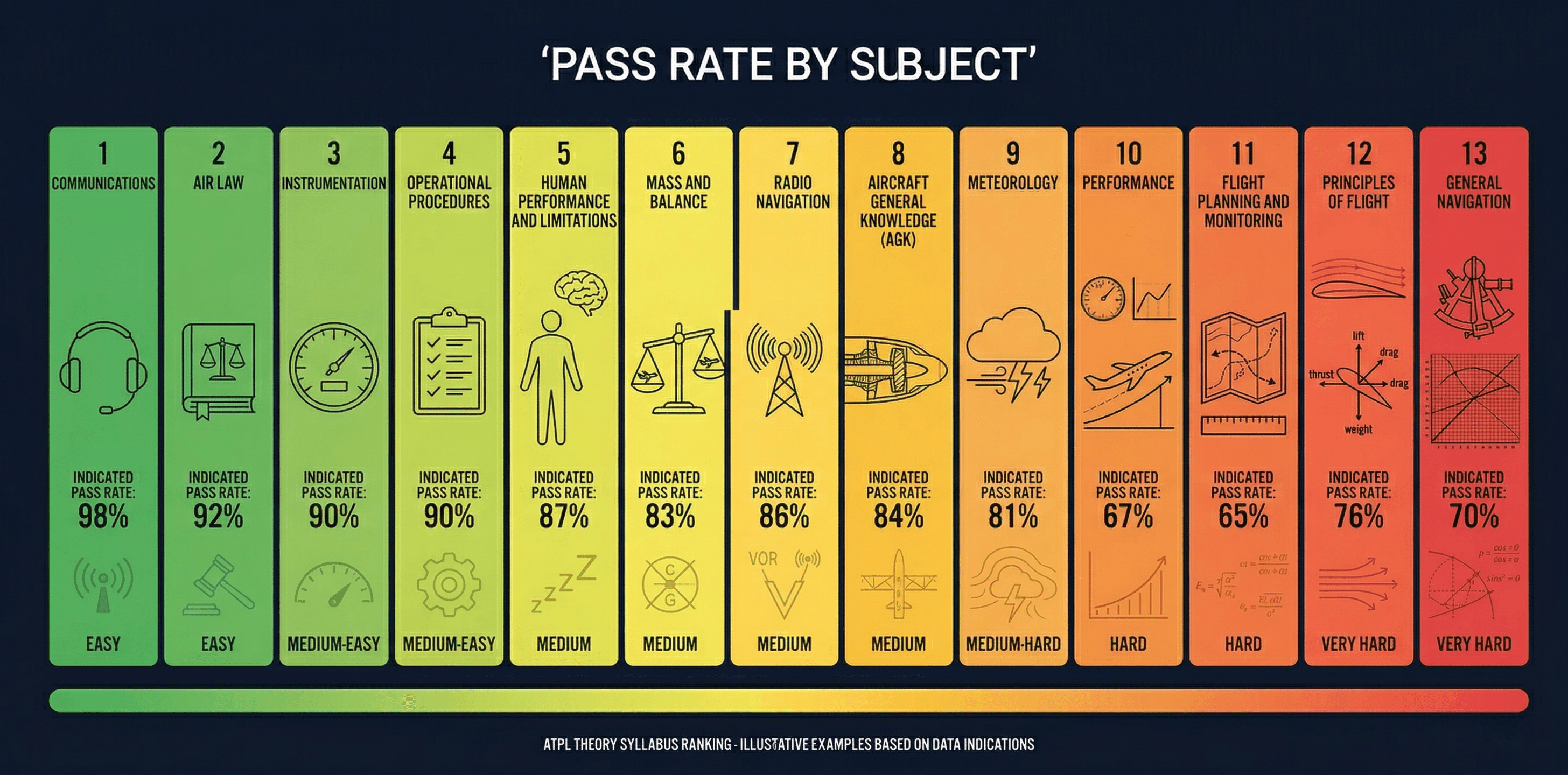
The 13 ATPL exams vary significantly in difficulty. Communications and Instrumentation consistently post the highest pass rates (above 85%), while Performance and Principles of Flight sit at the bottom with rates closer to 60%. The ranking below is based on EASA ECQB data and reflects the real experience of thousands of candidates — not what the textbooks tell you.
Why This Ranking Exists
Here's something nobody told me before I started my ATPL theory: the difficulty of these exams has almost nothing to do with how complex the subject is in real life.
I've passed all 13 ATPL exams. And the one thing I wish someone had handed me on day one was an honest, brutally clear ranking — not based on the theory behind each subject, but on what candidates actually experience when they sit in that exam room.
This guide is that ranking.
It's built on EASA ECQB 2021 pass rate data, the experience of hundreds of candidates, and the very specific weirdness of how EASA frames its questions. You'll find the number of questions, the time allowed, and one honest piece of advice for each subject.
No fluff. Let's go.
The 13 ATPL Subjects Ranked
Ranked from easiest to hardest based on real pass rates
#1 — Communications
Questions: 34 | Time: 45 minutes | Pass Rate: ~90%
Communications is, by a clear margin, the most passable of the 13 ATPL exams. If you already hold a PPL, much of this content will feel familiar — phraseology, distress and urgency procedures, ATC communication rules.
The questions are direct. There are no tricks hidden in graphs or formulas. It's memory and application.
Honest tip: Don't sleepwalk through it. People have failed Communications by being overconfident and rushing. Read every question twice, watch for the EASA wording traps, and treat it with the same respect you'd give any other subject.
#2 — Instrumentation
Questions: 60 | Time: 90 minutes | Pass Rate: ~87%
Instrumentation covers the systems and instruments in the cockpit — speed measurement, gyroscopic instruments, navigation systems, and monitoring equipment. It's logical, methodical, and very learnable.
There's no complex maths involved. Once you understand why an instrument works the way it does, the answers follow naturally.
Honest tip: The question bank is your best friend here. The questions are highly repetitive across EASA authorities. Hit the bank hard, understand the underlying principle behind each answer, and you'll sail through this one.
#3 — Human Performance & Limitations (HPL)
Questions: 48 | Time: 60 minutes | Pass Rate: ~84%
HPL — fatigue, stress, cognition, crew coordination, hypoxia, spatial disorientation. This is essentially applied psychology for pilots, and for most people it's surprisingly enjoyable to study.
The challenge is that it's a pure memory exam. There's no formula to derive the answer from first principles. You either know what EASA considers the correct model of human behaviour, or you don't.
Honest tip: Learn the EASA-approved frameworks (Swiss Cheese Model, Reason's model, threat and error management). Don't rely on common sense — EASA sometimes has a very specific answer that contradicts what you'd do instinctively as a rational person.
#4 — Air Law
Questions: 44 | Time: 60 minutes | Pass Rate: ~82%
Air Law sits comfortably in the upper half of the ranking — but only if you commit to memorising a lot of very specific regulation numbers, time limits, and licence requirements.
It's 100% a memory test. There's no conceptual reasoning to rely on. The pass rate is relatively high because the question bank covers the vast majority of what shows up in the real exam.
Honest tip: About 70% of the questions are banked, which is great. But there are always a handful of curveballs from deep inside EASA regulations that no amount of question bank drilling will prepare you for. Accept that going in. Study the material, hit the bank hard, and move on.
#5 — Mass & Balance
Questions: 25 | Time: 60 minutes | Pass Rate: ~79%
Mass & Balance is one of the shortest ATPL exams and involves centre of gravity calculations, loading envelopes, and basic graph interpretation. If you're comfortable with simple maths and can read a chart, this is manageable.
The exam is short enough that time pressure rarely becomes a problem. The real risk is making a careless arithmetic error.
Honest tip: Practice the calculations until they're automatic. Always double-check your units. One misplaced decimal point can cost you a question that should have been free points.
#6 — Aircraft General Knowledge (AGK)
Questions: 80 | Time: 120 minutes | Pass Rate: ~76%
AGK is a broad, substantial exam covering airframes, hydraulics, pneumatics, fuel systems, electrics, and powerplants. The sheer breadth of material is what makes it demanding — not the depth.
There's a lot to learn, and the questions span an enormous range of topics. You can spend weeks studying one system and still get caught out on a small detail in another.
Honest tip: Build a systematic overview first, then drill deep. Don't try to memorise AGK by brute force — understand how each aircraft system works logically, and the details will stick far more effectively.
#7 — Operational Procedures
Questions: 45 | Time: 75 minutes | Pass Rate: ~74%
Operational Procedures is an interesting case. The pass rate looks decent on paper, but almost every candidate will tell you it feels harder than the number suggests.
Why? Because the exam routinely throws questions drawn from obscure corners of EU-OPS or EASA standards — situations that even experienced line pilots would need to check an ops manual to answer. This is a subject where diligent study doesn't always translate directly into exam marks.
Honest tip: The stats are on your side, but prepare for frustration. Go deep into the question bank and accept that some questions will genuinely stump you. Don't let a bad question derail your focus mid-exam.
#8 — Meteorology
Questions: 84 | Time: 120 minutes | Pass Rate: ~71%
Meteorology is where the exam starts to genuinely bite. The subject matter is fascinating — weather systems, METAR decoding, icing, thunderstorms, atmospheric pressure — but EASA has a way of making even straightforward concepts feel oddly specific.
The question bank coverage is decent, but there are enough surprise questions that you can't rely on it alone. You need to actually understand the meteorology.
Honest tip: If this is one of your first modules (as it often is at integrated schools), the difficulty feels amplified because you're still figuring out how to study. Give it the time it deserves. The foundations you build here will serve you throughout your career.
#9 — Radio Navigation
Questions: 66 | Time: 90 minutes | Pass Rate: ~69%
Radio Navigation covers VOR, ILS, DME, ADF, RNAV, GPS, radar — the full suite of navigation aids you'll actually use in the airline world. The concepts are inherently technical, and the questions require both understanding and application.
Time pressure becomes a real factor here. Sixty-six questions in 90 minutes leaves you less than 90 seconds per question, and some of them involve calculations.
Honest tip: Aim for 90-95% accuracy in practice before you sit this one. The question bank is very representative of what shows up in the real exam. Understand why each navigation system works the way it does — rote memorisation alone won't carry you through the applied questions.
#10 — General Navigation
Questions: 60 | Time: 120 minutes | Pass Rate: ~67%
General Navigation — charts, great circles, rhumb lines, wind calculations, map projections — is the exam that genuinely humbles candidates who underestimate it. On first look it seems manageable. Then you realise how much precise maths is involved and how easy it is to make compounding errors.
The exam is heavily calculation-based. Bring your CRP-5 and know how to use it without hesitation.
Honest tip: Practice speed. Many candidates who know the material perfectly still struggle to finish on time. The CRP-5 and chart calculations need to be automatic, not laboured over.
#11 — Flight Planning & Monitoring
Questions: 43 | Time: 120 minutes | Pass Rate: ~65%
Flight Planning combines elements of navigation, performance, fuel, and regulations into one comprehensive exam. It's one of the most practical subjects — almost everything you study here has a direct application in real airline operations.
But the exam is intense. Few questions, long duration, complex multi-step problems. One wrong calculation at step one ripples through the rest of your working.
Honest tip: Practice complete fuel planning problems from start to finish. Don't just drill individual question types in isolation. The exam tests your ability to integrate knowledge, not just recall it.
#12 — Principles of Flight
Questions: 46 | Time: 90 minutes | Pass Rate: ~62%
Principles of Flight covers lift, drag, stall, the four forces, high-speed aerodynamics, compressibility effects, and more. It requires genuine conceptual understanding — you cannot memorise your way through this one.
The questions are regularly updated, the concepts interlink in subtle ways, and EASA excels at asking about edge cases (swept wing behaviour, coffin corner, Mach tuck) that are genuinely difficult.
Honest tip: Don't rush this subject. Build a solid conceptual foundation before you start the question bank. Students who dive into the bank too early develop habits of guessing on the hard questions rather than actually understanding the physics.
#13 — Performance
Questions: 61 | Time: 120 minutes | Pass Rate: ~58%
Performance is the hardest ATPL exam. Full stop.
It combines complex graph reading, multi-variable calculations, regulatory knowledge, and time pressure into a genuinely demanding experience. Climb gradients, obstacle clearance, field length requirements, drift-down procedures — the scope is enormous and the precision required is unforgiving.
The silver lining? Performance is also one of the most directly useful subjects you'll study. You'll use this knowledge every single day as a commercial pilot.
Honest tip: Give Performance more preparation time than any other subject. Aim for 90%+ in practice sessions before you sit the real exam. The question bank is representative, but the exam will still test your ability to read graph intersections under pressure and in limited time.
Key Takeaways
- No ATPL subject is easy — even Communications (the "easiest") has caught out overconfident candidates.
- The question bank is essential, but it's not enough on its own. You need to understand the material, especially for the bottom five subjects.
- Performance and Principles of Flight deserve significantly more preparation time than the rest.
- Operational Procedures feels harder than its pass rate suggests — expect curveball questions from deep in the regulations.
- Studying the subjects in a logical sequence matters. Build your foundations in the easier subjects before tackling the calculation-heavy ones.
- AI-powered simulators and adaptive quizzing (like what ClearATPL offers at clearatpl.com) dramatically accelerate preparation by exposing your weak areas before the real exam does.
FAQ
How many times can you resit an ATPL exam if you fail?
Under EASA regulations, you have a maximum of 6 attempts per subject across 3 sittings (per sitting, you can attempt multiple subjects). If you exhaust all attempts on a subject, you must restart the full theoretical knowledge course.
What is the minimum pass mark for ATPL exams?
The minimum passing score is 75% for all ATPL subjects under EASA regulations.
How long are ATPL exam passes valid?
Passed ATPL theoretical knowledge exams remain valid for the issue of an ATPL for 7 years from the last validity date of an Instrument Rating entered in your licence.
Do I need to pass all 13 exams before starting flight training?
No. Under the modular route, many candidates sit exams in groups (sittings) and begin hour-building or CPL training in parallel. Under the integrated route, exams are typically completed before or during flight training — your ATO will define the sequence.
Is it possible to pass all 13 ATPL exams without a question bank?
Technically possible, but highly inadvisable. The EASA question style is very specific and often counter-intuitive. The data is clear: candidates who use question banks extensively pass at significantly higher rates than those who rely on textbooks alone.
Which ATPL subject should I study first?
Most ATOs will determine the sequence for you. If you have a choice, many experienced instructors recommend starting with Communications, Air Law, and HPL — they're more memory-based and help you build study momentum before tackling the calculation-heavy subjects.
Conclusion
The 13 ATPL exams aren't just a regulatory hurdle — they're a genuine education in the science and safety of commercial aviation. The subjects at the top of this ranking (Communications, Instrumentation) will feel manageable with consistent study. The subjects at the bottom (Performance, Principles of Flight) will challenge you in ways that are directly relevant to the job you're training for.
The pilots who pass all 13 aren't necessarily the most naturally gifted. They're the ones who approach each subject with a plan, use the right tools, and understand their own weak areas before the exam room does.
If you're currently preparing for your ATPL theory, ClearATPL offers adaptive AI-powered quizzes across all 13 subjects and a full airline interview simulator built by pilots who've been through exactly this process.