
Quick Answer: Most ATPL candidates fail not because the material is too hard, but because they study the wrong way. These 8 strategies — built on how memory actually works, how EASA actually writes questions, and how real airline pilots actually prepared — will fundamentally change how you approach your theory. Implement even half of them and you'll notice a difference within weeks.
The Real Reason People Fail ATPL Exams
Here's something most ATPL guides won't tell you.
The material isn't the problem. The 13 subjects are challenging — no question — but thousands of candidates pass them every year without being exceptional students or natural geniuses. The ones who struggle aren't failing because Performance or Principles of Flight are genuinely impossible. They're failing because of how they're studying.
I've passed all 13 ATPL exams. And looking back, the strategies that made the difference weren't about working harder. They were about working in a completely different way.
This isn't a list of vague tips. These are 8 specific, actionable strategies that address the most common failure modes — the ones that cost candidates months of wasted preparation and unnecessary resits.
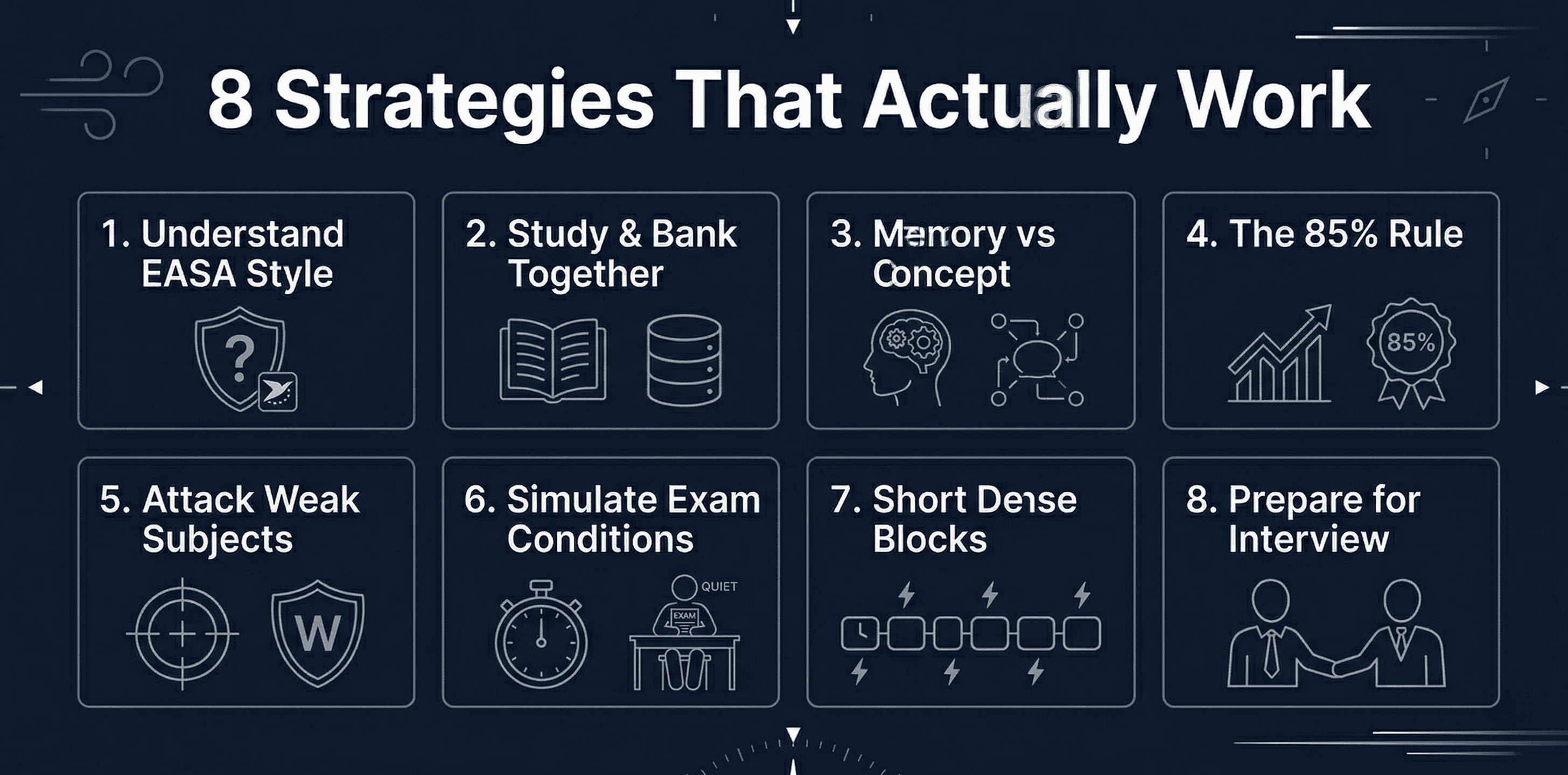
Strategy 1: Understand the EASA Question Style Before You Study Anything
Before you open a single textbook, spend a few hours getting familiar with how EASA constructs its questions.
This sounds like a detour. It isn't. EASA questions are not straightforward knowledge checks. They are carefully worded, often deliberately ambiguous, and sometimes constructed so that the "obviously correct" answer is a trap. Candidates who learn the material perfectly and then encounter EASA's question style for the first time in an exam setting are caught off guard — and it costs them marks.
Spend time early on:
- Reading through sample questions across multiple subjects without worrying about getting them right
- Noticing how EASA tends to word distractors (wrong answers that sound plausible)
- Identifying the patterns in how they test applied knowledge vs. pure recall
Once you understand the game, you can study for it intentionally. You'll read every question with the right level of suspicion and attention to wording.
Strategy 2: Study and Bank Simultaneously — Never Sequentially
The biggest mistake ATPL students make is this: they study a full subject, finish it, and then go to the question bank.
By that point, they've forgotten 40–60% of what they covered at the start.
The correct approach is to integrate the question bank from day one. As soon as you finish a topic or sub-topic in your course materials, immediately go to the question bank, filter by that specific topic, and work through every question available. Don't wait. Do it the same day.
This does three things at once:
- It forces you to actively retrieve what you just studied (the single most effective memory technique that exists)
- It immediately exposes the gap between what you learned and how EASA will test it
- It builds a feedback loop: wrong answers send you straight back to the material, not weeks later
Simultaneous study and banking isn't just more efficient. It's a fundamentally different learning architecture.
Strategy 3: Distinguish Memory Subjects from Concept Subjects
Not all 13 subjects should be studied the same way. Treating them identically is one of the most common and costly mistakes.
Memory subjects — Air Law, Communications, Operational Procedures, HPL — are primarily about recall. The material itself isn't complex, but the volume is enormous. For these, spaced repetition, flashcards, and relentless question bank drilling are your tools.
Concept subjects — Principles of Flight, Performance, General Navigation, Flight Planning — require genuine understanding. You cannot memorise your way through these. A candidate who tries to rote-learn Performance will fail regardless of how many hours they spend, because the exam tests applied reasoning, not recall.
For concept subjects, spend more time with diagrams, worked examples, and understanding the why behind each principle. The question bank is still essential, but it comes second — understanding first, drilling second.
For memory subjects, you can lean more heavily on the bank from the start. The material is learnable through repetition in a way that Performance is not.
This distinction alone can save you weeks of misallocated study time.
Strategy 4: Use the 85% Rule to Know When You're Ready
One of the most common questions ATPL students ask is: "How do I know when I'm ready to sit an exam?"
Here's a clear answer: you should be consistently scoring above 85% in timed, full-length practice exams for that subject before you book the real thing.
Not 85% on topic-by-topic drills. Not 85% on untimed practice. 85% on complete, timed mock exams that simulate real conditions.
Why 85% and not 75% (the pass mark)?
Because real exam conditions — stress, time pressure, seeing questions in unfamiliar formats — typically reduce your performance by 10 to 15 percentage points compared to practice. Candidates who book their exam after hitting 77% in practice are gambling. Candidates who wait for consistent 85–90% are not.
It feels frustrating to delay a sitting when you're close. But one failed attempt costs you one of your limited resit opportunities. That is a far greater cost than an extra two weeks of preparation.
Strategy 5: Attack Your Weak Subjects First, Every Single Session
Human psychology is predictable: we naturally gravitate toward the topics we already understand because it feels productive and comfortable. It isn't.
If you open a study session by working on General Navigation when you're already solid at General Navigation, you've just wasted your most focused, highest-quality study time on material you don't need.
Every study session should start with your weakest subject or your lowest-scoring topic. Without exception.
Your brain is sharpest at the beginning of a session. The material you encounter when you are most alert and focused is the material that sticks most effectively. Give that cognitive advantage to the subjects that actually need it.
This strategy requires discipline because it feels uncomfortable. You will open a session knowing you're about to work on something difficult. That discomfort is the signal that you're doing it right.
Strategy 6: Simulate Exam Conditions Regularly
The exam room has a way of making things fall apart that were perfectly solid in practice.
Time pressure. A confusingly worded question early in the paper that derails your confidence. The temptation to change an answer you got right the first time. These are the psychological and procedural elements of exams — and they are trainable, but only if you practice in conditions that replicate them.
From roughly four weeks before each sitting, include at least two full timed mock exams per subject per week. During these mocks:
- Use only the tools you'll have in the real exam
- Simulate the time limit without pausing
- Do not check answers mid-exam
- After the exam, analyse every wrong answer in detail — not just what the right answer was, but why EASA considers it correct
The goal isn't just to test your knowledge. It's to develop the pacing, the decision-making under pressure, and the mental stamina that the real exam demands.
Strategy 7: Study in Short, Dense Blocks — Not Long, Passive Sessions
Six hours of passive reading is worth less than two hours of active, focused retrieval practice. This is not an opinion — it's one of the most well-established findings in cognitive science.
The ATPL course tempts you into long study sessions because the volume of material feels overwhelming. The psychological response is to sit with a textbook for as long as possible and feel like you're making progress.
You're not.
Structure your study around 45–60 minute blocks with clear objectives set before each session. At the end of each block, write down — from memory, without looking — the three to five key points you just covered. This forces active retrieval and immediately reveals what didn't stick.
Take real breaks between blocks (not scrolling your phone). Your brain consolidates information during rest, not during continuous exposure.
Candidates who study 90 minutes a day with intense focus and active retrieval consistently outperform candidates who study five passive hours. The science is clear, and the ATPL results confirm it.
Strategy 8: Prepare for the Airline Interview While You Study Theory
This one most guides completely ignore — and it's arguably the most strategically valuable thing on this list.
The airline interview is where your ATPL theoretical knowledge gets tested for the second time, but under entirely different conditions. You're not multiple-choice ticking in an exam room. You're sitting across from a panel of experienced pilots who are testing whether you can explain what you know, think through a technical scenario in real time, and communicate clearly under pressure.
Candidates who treat the airline interview as something to prepare for after they finish theory are starting from zero at the worst possible moment. They've let the material go cold.
The smarter approach: as you study each subject, also think about how you would explain the key concepts out loud to a non-expert. When you cover Performance, ask yourself — could I walk a panel through a Take-Off Analysis scenario verbally? When you study Meteorology, could I explain why a microburst is particularly dangerous on final approach?
This dual-purpose study approach means your theory knowledge is deeper (because you're processing it at a higher level), and your interview preparation is already underway when you need it.
Tools like ClearATPL are specifically built for this — combining adaptive ATPL quizzes with an AI-powered airline interview simulator so you're building both skills simultaneously, not sequentially.
Key Takeaways
- The question bank is not the end goal — it's a feedback tool. Use it to expose gaps and reinforce learning, not to memorise answers in isolation.
- Never study a full subject before touching the bank. Integrate question bank work from the first day of each topic.
- Concept subjects and memory subjects require completely different approaches. Trying to memorise your way through Performance will fail every time.
- Don't book an exam until you're consistently hitting 85%+ on timed mocks. One failed sitting costs far more than an extra two weeks of prep.
- Always start with your weakest area. Your best cognitive hours should go to the material that needs it most.
- Short, focused, active sessions beat long passive ones — every time, without exception.
- Start preparing for your airline interview during theory study, not after. The overlap is enormous and the benefits compound.
FAQ
How long does it take to prepare for the ATPL theory exams? Preparation time varies significantly depending on your route (integrated vs. modular) and background. Most integrated students complete theory over 6–9 months of full-time study. Modular students typically take 12–18 months while managing other commitments. Prior academic background in maths and science makes a noticeable difference in the calculation-heavy subjects.
Can I study for ATPL exams without attending a ground school? Under EASA regulations, ATPL theoretical knowledge training must be completed at an approved ATO (Aviation Training Organisation). However, the ATO's instruction can be delivered online or in a blended format, so in-person attendance is not always required. Self-study with a question bank alone is not sufficient or compliant.
How many subjects should I attempt per sitting? Most candidates sit 3–5 subjects per sitting. The right number depends on your preparation level — it is far better to attempt fewer subjects with high confidence than to rush all 13 through in two sittings with borderline preparation. Remember: each subject has a limited number of resit attempts.
What happens if I fail an ATPL subject three times? Under EASA Part-FCL regulations, each subject may be attempted a maximum of six times across three sittings. If you use all six attempts on a subject without passing, you must retake the full theoretical knowledge course before you can attempt that subject again. The stakes are high — don't rush your sittings.
Is the question bank enough on its own to pass? No. The question bank is a critical tool, but relying on it exclusively means you're memorising answers rather than understanding concepts. The harder subjects — Performance, Principles of Flight, Flight Planning — will expose this gap immediately. Quality ground school material combined with rigorous question bank practice is the correct approach.
Do ATPL exams expire? Yes. Under EASA regulations, a pass in ATPL theoretical knowledge exams remains valid for the issue of an ATPL for 7 years from the last validity date of an Instrument Rating entered in your licence.
Conclusion
Passing the ATPL theory exams is not about being smarter than other candidates. It's about preparing more intelligently.
The 8 strategies in this guide address the real failure modes — not the subject difficulty, but the study habits, the exam psychology, and the strategic errors that cost candidates time, money, and resit attempts.
Apply them systematically. Treat your preparation like the professional training it is. And remember that the goal isn't just to pass 13 exams — it's to build a foundation of knowledge that will serve you in airline interviews, type rating courses, and your entire career on the line.
If you're currently in your ATPL theory, ClearATPL offers adaptive AI-powered quizzes across all 13 subjects and a built-in airline interview simulator — so you can implement Strategy 8 from day one. You can also check out our complete guide to the 13 ATPL subjects ranked by difficulty if you want to know where to focus your energy first.