Quick Answer: RNAV (Area Navigation) and RNP (Required Navigation Performance) are both navigation specifications under the ICAO PBN framework. The single most important difference: RNP includes on-board performance monitoring and alerting (OBPMA) — RNAV does not. This distinction drives almost every exam question on the topic. This guide explains both specifications clearly, covers all EASA-relevant NavSpecs, and flags the question patterns that catch candidates most often.
Table of Contents
- The Big Picture: What Is PBN?
- The Three Performance Requirements: CIA
- RNAV — Area Navigation
- RNP — Required Navigation Performance
- RNAV vs RNP: The Key Distinctions
- Lateral Accuracy Values — What the Numbers Mean
- Waypoint Types: Fly-By vs Fly-Over
- PBN in Each Phase of Flight
- EASA Exam Traps on RNAV and RNP
- Key Takeaways
- FAQ
- Conclusion
The Big Picture: What Is PBN?
Before ICAO introduced Performance-Based Navigation in 2007, navigation requirements were defined by the equipment an aircraft carried — 'you must have a VOR receiver', 'you must have an ILS'. This equipment-based approach was inflexible and couldn't keep pace with the diversity of modern avionics.
PBN changed the model entirely. Instead of specifying equipment, it specifies outcomes — the level of navigation performance that must be achieved, regardless of which sensors or systems are used to achieve it. An aircraft can meet a PBN requirement using GPS, DME/DME, inertial navigation, or a combination — as long as the required performance standard is consistently met.
Under PBN, every navigation requirement is expressed as a Navigation Specification (NavSpec). There are two families of NavSpec:
- RNAV specifications — define accuracy and functional requirements, but do NOT require the aircraft to monitor its own performance
- RNP specifications — include all RNAV requirements PLUS the mandatory requirement for on-board performance monitoring and alerting
Everything else in this article is an elaboration of that single distinction.
The Three Performance Requirements: CIA
Every NavSpec — whether RNAV or RNP — is defined by three performance requirements. The mnemonic CIA keeps them in order:
| Letter | Requirement | What it means |
|---|---|---|
| C | Continuity | Navigation guidance remains uninterrupted throughout the phase of flight. Short signal losses that degrade guidance are a continuity failure. |
| I | Integrity | The system can detect and alert the crew when position data is unreliable. Integrity is what makes RNP safer than basic RNAV — the aircraft actively monitors its own trustworthiness. |
| A | Accuracy | The aircraft stays within the specified lateral distance from the centreline 95% of the flight time. This is the number you see in the NavSpec name — e.g. RNAV 1 means ±1 NM accuracy at 95%. |
Exam tip: EASA asks which performance requirements define a PBN navigation specification. The answer is always: accuracy, integrity, and continuity. Availability is sometimes listed in distractors — it is a related concept but not one of the three primary CIA requirements.
RNAV — Area Navigation
What RNAV means
Area Navigation means the aircraft can fly on any desired flight path — not just along airways defined by ground-based navaids. The flight management system (FMS) computes position using available sensors and generates guidance to follow a defined route.
Critically, RNAV does not require the system to automatically tell the crew if its position calculation becomes unreliable. The pilot is responsible for cross-checking and detecting degradation. This is the absence of OBPMA — and it is the fundamental RNAV limitation that RNP resolves.
RNAV specifications
RNAV 10 | Phase: Oceanic and remote continental | Accuracy: ±10 NM
Confusingly named — despite 'RNAV 10', this pre-dates PBN and has grandfather rights from when it was called RNP 10. Despite the name, it does NOT require OBPMA. It is a true RNAV specification.
RNAV 5 | Phase: Continental en route | Accuracy: ±5 NM
Also known historically as Basic RNAV (B-RNAV). Used for en route airways in Europe. Minimum equipage includes one of: VOR/DME, DME/DME, GNSS, or inertial navigation.
RNAV 2 | Phase: En route and terminal | Accuracy: ±2 NM
Used in the continental en route environment and for some terminal area procedures. GNSS is typically the primary sensor.
RNAV 1 | Phase: SIDs, STARs, and terminal | Accuracy: ±1 NM
The most operationally significant RNAV specification. Mandated for SIDs and STARs in European airspace. Also known historically as Precision RNAV (P-RNAV). RNAV 1 is the minimum for future European terminal procedures — all conventional SIDs/STARs will eventually be replaced or backed up by RNAV 1/RNP 1 procedures.
RNP — Required Navigation Performance
The defining difference: OBPMA
On-Board Performance Monitoring and Alerting means the navigation system continuously calculates whether it is achieving the required accuracy, and automatically alerts the crew if it cannot. This alert appears as an FMS annunciation — typically 'UNABLE RNP' or similar, depending on the aircraft type.
The practical consequence for ATC is significant. Because an RNP-equipped aircraft can guarantee its track-keeping performance to a defined standard and will alert if it cannot, controllers can place routes and approach paths closer together than would be possible with basic RNAV aircraft. This enables curved approach paths, closely-spaced parallel operations, and procedures into terrain-constrained airports that are not possible with RNAV.
The critical rule: RNP = RNAV + OBPMA. Every RNP specification includes all the requirements of an equivalent RNAV specification, plus the mandatory performance monitoring and alerting. This is the one sentence that covers 80% of EASA questions on this topic.
RNP specifications
RNP 4 | Phase: Oceanic and remote continental | Accuracy: ±4 NM
Designed for oceanic operations with FANS 1/A capability (CPDLC and ADS-C). Requires GPS and includes OBPMA. Enables reduced oceanic separation standards — 23 NM lateral and 30 NM longitudinal — compared to conventional oceanic minima.
RNP 2 | Phase: Oceanic, remote and continental en route | Accuracy: ±2 NM
A newer specification bridging oceanic and continental operations. Requires GNSS and includes OBPMA. Supports more efficient routing in remote airspace with limited radar coverage.
RNP 1 | Phase: Terminal area: SIDs and STARs | Accuracy: ±1 NM
The RNP equivalent of RNAV 1, with the addition of OBPMA. Used for SIDs and STARs where the monitoring requirement provides additional assurance in complex terminal environments.
RNP APCH | Phase: Instrument approaches | Accuracy: ±0.3 NM on final
The standard RNP approach specification, used for RNAV(GNSS) approaches worldwide. Offers multiple lines of minima:
- LNAV — lateral guidance only, no vertical guidance (2D approach)
- LNAV/VNAV — lateral guidance with barometric vertical navigation (3D)
- LPV — lateral and vertical guidance via SBAS (equivalent to CAT I ILS)
- LP — lateral precision only, SBAS-based
The accuracy tightens to ±0.3 NM on the final approach segment. This is the most widely used PBN approach specification in Europe.
RNP AR APCH | Phase: Approaches requiring special authorisation | Accuracy: As low as ±0.1 NM
Authorization Required approaches. These use curved (RF — Radius to Fix) segments and very tight accuracy requirements, enabling approaches into terrain-constrained airports that conventional or standard RNP APCH cannot serve. Requires specific aircraft certification, crew training, and operator approval — it is not available to all operators by default.
RNAV vs RNP: The Key Distinctions
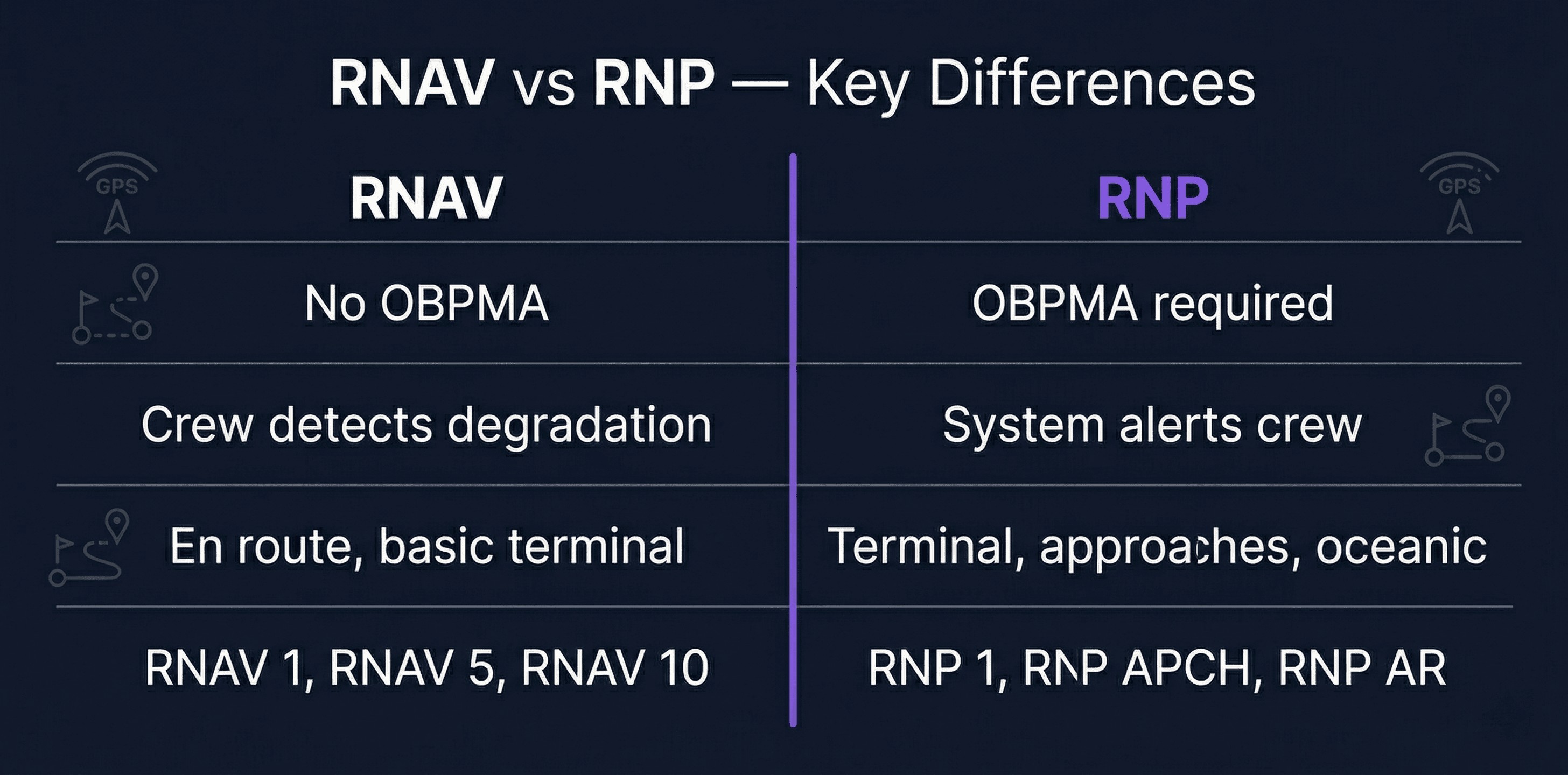
| Feature | RNAV | RNP |
|---|---|---|
| Full name | Area Navigation | Required Navigation Performance |
| On-board monitoring & alerting (OBPMA) | NOT required | MANDATORY |
| Crew notified of degradation? | No — crew must detect manually | Yes — automatic alert |
| ATC confidence in tracking | Lower — no self-monitoring guarantee | Higher — system guarantees performance or alerts |
| Enables curved approaches? | No | Yes (RNP AR APCH) |
| Typical application | En route, basic terminal procedures | Terminal, approaches, oceanic with precision |
| Example specifications | RNAV 5, RNAV 2, RNAV 1, RNAV 10 | RNP 4, RNP 1, RNP APCH, RNP AR APCH |
Lateral Accuracy Values — What the Numbers Mean
The number in a NavSpec name — RNAV 1, RNP 4, RNP AR 0.1 — is the lateral accuracy requirement expressed in nautical miles. It means the aircraft must remain within that distance from the centreline of the route or procedure for at least 95% of flight time.
This is called the Total System Error (TSE). It encompasses all sources of error — navigation system error, flight technical error (how well the autopilot tracks), and path definition error.
For RNP specifications, there is an additional containment value. The containment boundary is typically twice the accuracy value. This means that for RNP 1, the aircraft must stay within ±1 NM for 95% of the time, and within ±2 NM for 99.999% of the time. The probability of exceeding the containment boundary without an alert must be extremely small — this is what OBPMA guarantees.
| NavSpec | Accuracy (95%) | Phase of flight | OBPMA? |
|---|---|---|---|
| RNAV 10 / RNP 10* | ±10 NM | Oceanic | No* |
| RNAV 5 | ±5 NM | En route | No |
| RNAV 2 | ±2 NM | En route, terminal | No |
| RNAV 1 | ±1 NM | SIDs, STARs | No |
| RNP 4 | ±4 NM | Oceanic | Yes |
| RNP 2 | ±2 NM | Oceanic, remote en route | Yes |
| RNP 1 | ±1 NM | Terminal | Yes |
| RNP APCH | ±0.3 NM (final) | Approach | Yes |
| RNP AR APCH | As low as ±0.1 NM | Approach (special auth) | Yes |
RNAV 10 is formally called 'RNP 10' due to historical naming before PBN, but does NOT include OBPMA. It is effectively an RNAV specification despite the RNP prefix — a deliberate EASA exam trap.
Waypoint Types: Fly-By vs Fly-Over
RNAV and RNP procedures use two types of waypoints, and EASA tests the distinction directly.
Fly-By waypoint
The aircraft begins its turn before reaching the waypoint in order to smoothly intercept the next track segment. Turn anticipation is computed by the FMS based on groundspeed and the required track change. The aircraft does not fly overhead the waypoint — it cuts the corner. This is the standard waypoint type for most RNAV/RNP routes.
Fly-Over waypoint
The aircraft must fly overhead the waypoint before initiating any turn. No turn anticipation is permitted. After passing overhead, the aircraft turns to intercept the next segment. Fly-over waypoints are used where it is operationally necessary to ensure the aircraft has passed a specific point before turning — for obstacle clearance, noise abatement, or controlled airspace boundary reasons.
Exam tip: Fly-by waypoints allow turn anticipation — the turn starts before the waypoint. Fly-over waypoints require the aircraft to overfly before turning. EASA sometimes uses the phrasing 'precludes turn anticipation' to describe fly-over — know this wording.
PBN in Each Phase of Flight
Different NavSpecs apply to different phases of flight. This table shows what a typical European airline crew encounters:
| Phase | NavSpec used | Notes |
|---|---|---|
| Oceanic | RNAV 10, RNP 4, RNP 2 | Large lateral separation in oceanic airspace. RNP 4 enables reduced separation with ADS-C/CPDLC. |
| Continental en route | RNAV 5, RNAV 2 | Standard European airways. Most jet aircraft meet RNAV 5 minimum. |
| Terminal (SID/STAR) | RNAV 1, RNP 1 | RNAV 1 mandated for European SIDs/STARs. RNP 1 where monitoring is required by procedure design. |
| Approach | RNP APCH, RNP AR APCH | RNP APCH for standard RNAV(GNSS) approaches. RNP AR for curved or very tight minima — special approval required. |
EASA Exam Traps on RNAV and RNP
"RNP 10" is not really an RNP specification
RNAV 10, historically named RNP 10, does not include OBPMA. It predates the PBN manual and retained the RNP prefix by grandfather rights. EASA will sometimes offer "RNP 10 requires on-board monitoring" as a distractor — the correct answer is that it does not.
The 95% rule applies to both RNAV and RNP accuracy
The lateral accuracy value (e.g. ±1 NM for RNAV 1) must be met 95% of flight time for both RNAV and RNP specifications. The difference is not in the accuracy standard — it is in the monitoring and alerting requirement.
LNAV/VNAV is a 3D approach but not precision
Under the current EASA classification, approaches are described as 2D (lateral guidance only) or 3D (lateral and vertical guidance). LNAV/VNAV provides barometric vertical guidance and is therefore 3D — but it does not use glideslope, so it is not classified as a precision approach in the traditional sense. LPV approaches, using SBAS vertical guidance, offer CAT I ILS-equivalent performance.
RNAV 1 and RNP 1 have the same accuracy — but are different specifications
Both require ±1 NM at 95%. The difference is OBPMA. RNP 1 requires the system to monitor and alert; RNAV 1 does not. On a STAR, you may encounter either specification depending on the procedure design — the chart will indicate which applies.
RNP AR APCH requires special authorisation — it is not standard
Unlike RNP APCH, which is available to any appropriately equipped aircraft, RNP AR APCH requires a specific operational approval from the authority. The aircraft must be certified for RNP AR, the crew must be trained, and the operator must hold the approval. EASA tests whether candidates know that RNP AR is not automatically available with a standard PBN clearance.
The containment value is twice the accuracy value
For an RNP specification, the system must ensure that the probability of exceeding twice the accuracy value (the containment boundary) without an alert is negligibly small. For RNP 1, the containment boundary is ±2 NM. EASA may ask "what is the containment value for RNP 0.3?" — the answer is 0.6 NM.
Key Takeaways
- PBN defines navigation requirements by performance outcome — not by equipment. Any sensor combination can be used as long as the required standard is met.
- The single defining difference between RNAV and RNP is OBPMA. RNP requires the system to monitor its own performance and alert the crew if it cannot meet the required accuracy. RNAV does not.
- The three PBN performance requirements are CIA: Continuity, Integrity, Accuracy. Memorise this mnemonic.
- The number in a NavSpec name is the lateral accuracy in nautical miles, required 95% of flight time. RNAV 1 = ±1 NM. RNP 0.3 = ±0.3 NM.
- RNAV 10 (also called RNP 10) does NOT include OBPMA — despite the RNP prefix. It is a historical naming anomaly and an EASA exam trap.
- RNP APCH is the standard approach specification covering LNAV, LNAV/VNAV, LPV, and LP lines of minima. RNP AR APCH requires special authorisation and enables curved RF segments.
- Fly-by waypoints allow turn anticipation. Fly-over waypoints require the aircraft to overfly before turning.
- ClearATPL (clearatpl.com) covers the full Radio Navigation and General Navigation question sets, including all PBN topics, with adaptive quizzing that targets the traps above.
FAQ
What is the difference between PBN, RNAV, and RNP?
PBN (Performance-Based Navigation) is the overarching ICAO framework. Within PBN there are two families of navigation specifications: RNAV and RNP. RNAV defines accuracy and functional requirements without requiring on-board performance monitoring. RNP adds OBPMA to those requirements. Every RNP specification is a subset of PBN; every RNAV specification is also a subset of PBN. All three terms are often used loosely in conversation, but the EASA exam requires precision.
What does 'UNABLE RNP' mean on the FMS?
It means the navigation system has determined that it cannot currently meet the required accuracy for the RNP specification active on the procedure or route. The crew must immediately notify ATC, as the aircraft can no longer guarantee the track-keeping performance that the airspace design assumes. Depending on the phase of flight, this may require a missed approach, a clearance to a different procedure, or a hold.
Do all modern airliners have RNP capability?
Most modern jet airliners — A320 family, B737 NG/MAX, A330, B777, B787 and others — are certified for RNP APCH as standard. RNP AR APCH requires a separate certification process and not all aircraft or operators hold this approval. Older aircraft (pre-2000 production) may only meet RNAV specifications and lack the avionics for OBPMA.
What is an RF leg in RNP AR?
An RF (Radius to Fix) leg is a curved path segment defined by a fixed radius and a centre point, terminating at a specific waypoint. RF legs are exclusive to RNP AR APCH and enable curved approach paths around terrain or obstacles. They require the autopilot to be engaged throughout and cannot be flown manually.
Why does RNAV 1 matter for my ATPL?
RNAV 1 is the mandated minimum specification for SIDs and STARs across European airspace. Every IFR departure and arrival in Europe uses RNAV 1 or RNP 1 procedures. Understanding what the specification requires — and what it does not require (OBPMA) — is directly tested in the Radio Navigation and General Navigation ATPL subjects.
Conclusion
RNAV and RNP are not interchangeable terms, even though they are frequently used as if they were. The distinction — on-board performance monitoring and alerting — is small in one sense, but operationally significant in every sense. It determines the confidence ATC can place in an aircraft's track-keeping, which in turn determines how closely routes can be spaced and how demanding the approaches can be.
For the EASA exam, the framework is clear: PBN contains both RNAV and RNP. RNAV defines accuracy without self-monitoring. RNP adds OBPMA. The number in the name is the accuracy in nautical miles at 95%. RNAV 10 does not have OBPMA despite its name. RNP AR requires special approval.
Learn that structure, understand the CIA requirements, and know the phase-of-flight application for each specification — and every EASA PBN question becomes a pattern-matching exercise rather than a memory test.
ClearATPL (clearatpl.com) covers Radio Navigation and General Navigation with adaptive quizzes that identify exactly which PBN concepts need more work — so you go into the exam knowing the traps before EASA sets them.