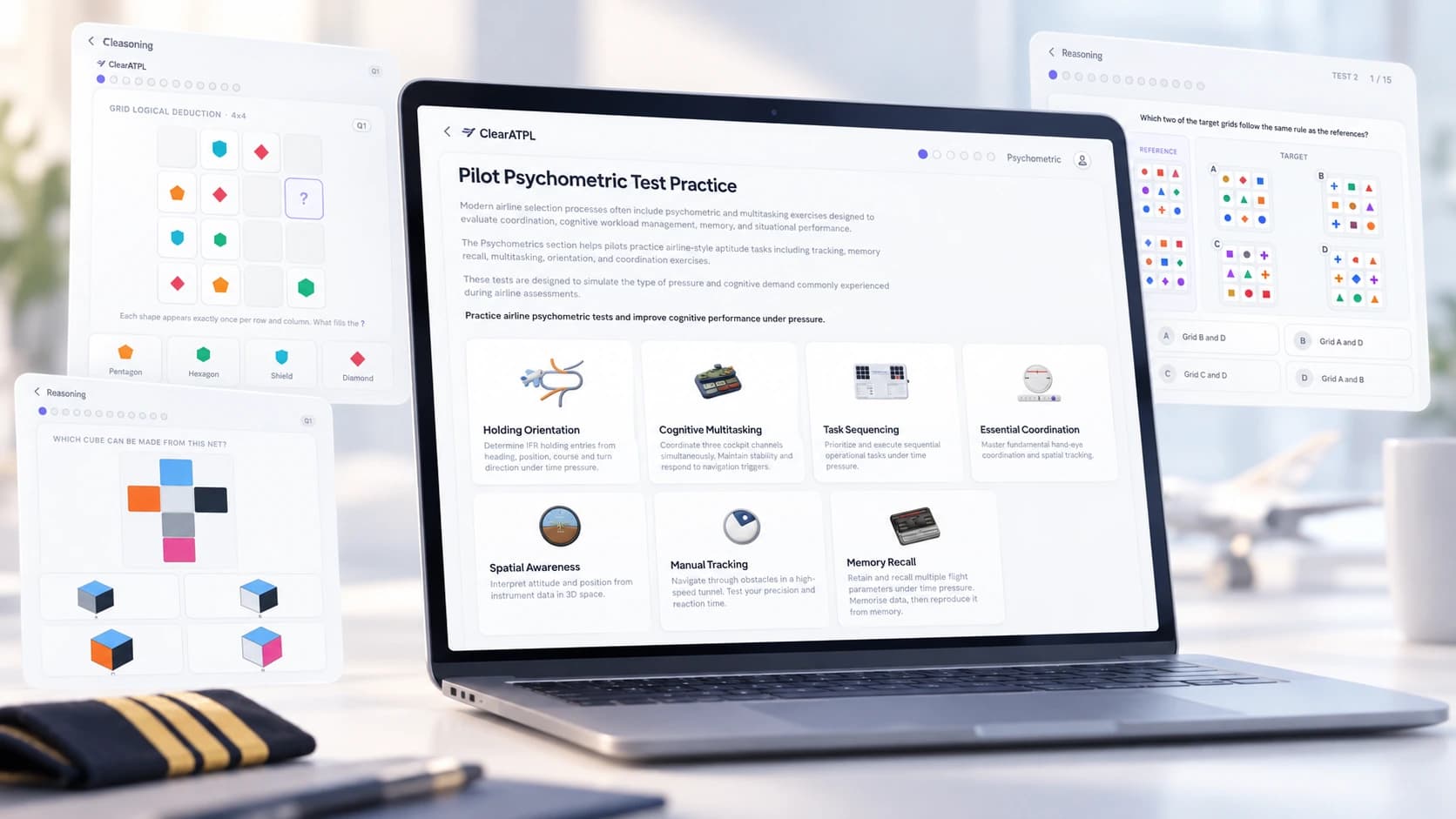
Quick Answer: Pilot psychometric tests are used to measure abilities and characteristics relevant to selection, such as reasoning, memory, attention, spatial processing, multitasking, coordination, and sometimes personality or work-style preferences. Reasoning tests are one part of this broader picture. Exact test batteries vary by airline and provider, but structured practice can improve familiarity, pacing, and consistency without relying on copied questions or trying to game personality measures.
Table of Contents
- What Pilot Psychometric Tests Actually Are
- Why Airlines Use Psychometric and Aptitude Assessment
- Psychometric vs Aptitude vs Reasoning vs Psychomotor
- The Main Skills You May Be Tested On
- Aon, ADAPT, COMPASS and the Provider Landscape
- Can You Prepare for Pilot Psychometric Tests?
- How to Train Effectively
- A Practical 7-Day Preparation Framework
- Common Preparation Mistakes
- What to Do on Assessment Day
- Key Takeaways
- FAQ
- Conclusion
- Sources and Further Reading
What Pilot Psychometric Tests Actually Are
Airline selection is not only a test of what you know. It is also an attempt to understand how you process information, learn, prioritise, maintain attention, coordinate tasks, and behave under pressure. That is where psychometric and aptitude assessment comes in.
In everyday pilot recruitment language, the term "psychometric test" is often used broadly. It may refer to cognitive ability tests, aptitude tests, personality questionnaires, or a wider battery that combines several of these. The important point is that these tools are designed to measure characteristics in a standardised way rather than simply asking whether you remember a fact from ATPL theory.
In European commercial air transport, psychological assessment also has a regulatory context. EASA CAT.GEN.MPA.175 requires flight crew to undergo a psychological assessment before commencing line flying, and the associated acceptable means of compliance lists cognitive abilities, personality traits, operational and professional competencies, and social competences among the assessment criteria. That regulatory assessment is not identical to every pre-employment aptitude screen, but it shows why airlines look beyond licences and technical knowledge when selecting flight crew.
Important: A psychometric battery is not one universal test. Two candidates applying to different airlines can both be told they have a "psychometric assessment" and still face very different tasks, timings, interfaces, and scoring methods.
Why Airlines Use Psychometric and Aptitude Assessment
A pilot must absorb large amounts of information, detect changes quickly, work accurately under time pressure, manage competing tasks, and remain effective in a crew environment. Selection batteries try to measure some of those underlying capabilities before an airline invests in further training.
IATA guidance on pilot aptitude testing treats selection as a broad competency problem rather than a single intelligence score. The goal is to understand a candidate across mental abilities, psychomotor and spatial abilities, operational capabilities, social-interpersonal abilities, and personality characteristics that may influence training and later performance.
For an airline, this provides a structured way to compare candidates who may have very different backgrounds. One applicant may have 220 hours after integrated training, another may have thousands of hours, and another may be entering through an ab-initio programme. A standardised assessment can add information that licences, grades, and interviews alone do not provide.
For the candidate, this means one thing: strong technical knowledge is still important, but it does not automatically translate into strong performance on a timed reasoning or multitasking task. Those are separate skills and should be prepared separately as part of a broader pilot assessment preparation plan.
Psychometric vs Aptitude vs Reasoning vs Psychomotor
These terms are often used interchangeably online, which creates unnecessary confusion. They are related, but they are not the same thing.
| Term | What it broadly means | Examples |
|---|---|---|
| Psychometric assessment | Standardised measurement of psychological characteristics, abilities or behaviour. It can include several different test types. | Cognitive tests, personality questionnaires, attention measures |
| Aptitude test | A test aimed at estimating capacity to learn or perform relevant tasks. | Reasoning, memory, spatial processing, multitasking |
| Reasoning test | A cognitive test focused on drawing conclusions from information or patterns. | Numerical, verbal, inductive, deductive, abstract reasoning |
| Psychomotor test | A task involving perception plus coordinated physical response. | Tracking, hand-eye or hand-foot coordination |
| Knowledge test | A test of learned information rather than underlying reasoning ability. | ATPL theory, maths knowledge, physics, aircraft systems |
A personality questionnaire belongs in the psychometric landscape too, but it is fundamentally different from a speeded reasoning test. It is not asking you to calculate faster or identify a hidden rule. It is trying to describe patterns in how you tend to behave, prefer to work, or respond to situations. Treating it like a puzzle with a secret "pilot answer" is usually the wrong approach.
The Main Skills You May Be Tested On
No airline uses every possible test, and provider batteries are configurable. Still, the same families of abilities appear repeatedly across aviation selection systems. Understanding the skill behind the task is more useful than memorising one interface.
Numerical reasoning
Numerical reasoning is the ability to interpret quantities, relationships, ratios, tables, graphs, and other numerical information accurately. It is not necessarily advanced mathematics. A candidate may understand the underlying maths perfectly and still lose marks by misreading a data set or working too slowly under time pressure. Effective preparation therefore combines core arithmetic fluency with careful interpretation.
Verbal reasoning
Verbal reasoning tests whether you can extract meaning from written information and make conclusions supported by that information. The challenge is often precision rather than vocabulary. Candidates get into trouble when they answer from general knowledge instead of using only what the passage or instructions actually support.
Abstract, inductive and deductive reasoning
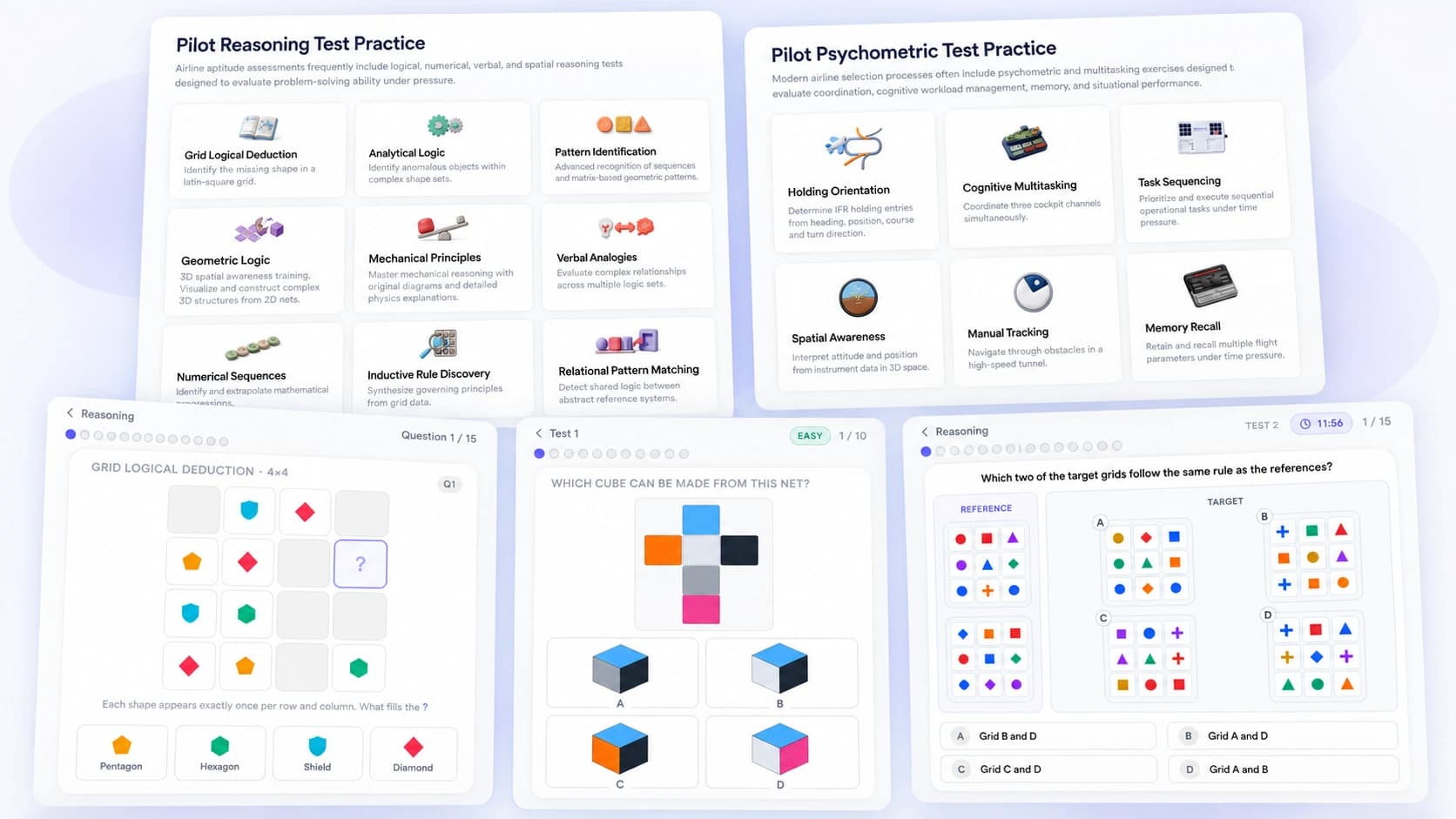
These tasks ask you to infer rules, relationships, or logical consequences from unfamiliar information. Inductive reasoning moves from examples toward a general rule; deductive reasoning applies rules or constraints to determine what must follow. In practice, pilot-selection interfaces may use shapes, sequences, matrices, or rule-based transformations. The useful skill is systematic pattern analysis, not memorising a library of visual tricks.
Spatial reasoning and orientation
Spatial tasks measure how well you understand position, orientation, rotation, and relationships in space. Aviation makes this especially relevant because pilots continuously translate between instruments, maps, outside references, headings, attitudes, and mental models of where the aircraft is. Practice should focus on building reliable spatial transformations rather than rushing through every item.
Working memory
Working memory is the ability to hold information temporarily while also doing something with it. A task may require you to remember values, positions, symbols, or instructions while processing new information. The difficulty rises quickly when multiple pieces of information compete for attention, which is why calm chunking and disciplined rehearsal strategies matter.
Perceptual speed, accuracy and attention
Some assessments reward fast detection of relevant signals, discrepancies, or patterns while penalising errors. The trap is assuming that maximum speed is always the goal. In many tasks, a slightly slower candidate with stable accuracy will outperform someone who produces a high volume of careless responses.
Multitasking and task management
Pilot multitasking is better understood as controlled allocation of attention than as doing everything at once. Selection tasks may ask you to monitor several information sources, respond to events, remember instructions, or prioritise concurrent demands. Strong performance usually comes from building a scan, protecting the highest-priority task, and recovering quickly after an interruption.
Psychomotor coordination
Psychomotor tasks combine perception with physical control. Depending on the assessment, this may involve tracking, compensatory control, or coordination using a joystick, pedals, keyboard, or another input device. Familiarity with the required hardware can reduce unnecessary cognitive load, but you should practise generic control skills rather than trying to reproduce a proprietary selection test.
Personality and work-style questionnaires
Personality questionnaires are designed to describe behavioural tendencies rather than test how quickly you can solve a problem. Aon, for example, distinguishes ability or performance tests from personality questionnaires. In aviation, psychological assessment may consider traits alongside cognitive and professional competencies. The practical rule is simple: read carefully and answer consistently and honestly. Trying to construct an imaginary "perfect pilot" profile can create contradictions across responses.
Knowledge tests are a separate category
Maths, physics, English, ATPL theory, aircraft systems, and company knowledge may appear in the same recruitment process, but they are not automatically reasoning tests. Knowledge can be revised directly. Cognitive aptitude is trained differently: by practising the underlying process, improving accuracy, and becoming comfortable with the format and time pressure.
Aon, ADAPT, COMPASS and the Provider Landscape
Candidates often search for the name of a specific provider because an invitation email, previous candidate report, or airline forum mentions one. That can be useful, but provider names should not distract from the underlying abilities being assessed.
Aon assessments
Aon publishes candidate preparation material for a wide range of online assessments, including numerical and verbal reasoning, inductive and deductive logic, working memory, concentration, planning, mechanical reasoning, and work-related behaviour questionnaires. Its own guidance emphasises reading the instructions and using the example exercises before starting the timed part. Many of the ability tests are deliberately speeded, so candidates may be asked to complete as many items as possible within a short period.
Symbiotics ADAPT
Symbiotics describes its cognitive reasoning assessment as covering verbal reasoning, numerical reasoning, working memory, perceptual speed and accuracy, spatial relationship reasoning, and abstract reasoning. Its broader aviation assessment products can also include multitasking, coordination, maths, physics, English, personality, and other components depending on the selection context.
EPST COMPASS
EPST describes COMPASS as a configurable pilot aptitude screening system. Its published material lists areas such as control and coordination, memory, task management, orientation, applied mathematics, technical comprehension, aviation English, and verbal reasoning, with differences between basic and advanced versions. Again, the exact battery depends on how the organisation configures the selection.
Independence note: ClearATPL is independent and is not affiliated with, endorsed by, or sponsored by Aon, Symbiotics, EPST, COMPASS, or any airline mentioned in this guide. Provider names are used descriptively. ClearATPL does not claim to reproduce official or proprietary assessment content.
The practical lesson is that you should prepare at two levels. First, understand the provider and instructions you have actually been given. Second, train transferable abilities - reasoning, memory, attention, spatial processing, task management, and coordination - so that a change of interface does not destroy your performance.
Can You Prepare for Pilot Psychometric Tests?
Yes - but "prepare" does not mean learning leaked questions. The useful gains come from format familiarity, technique, pacing, and targeted improvement in the underlying skill.
Aon explicitly recommends familiarising yourself with online tests and provides practice tasks and example sequences before the real assessment. Symbiotics similarly presents practice as a way to understand what to expect and identify weaker areas. That distinction matters: good preparation reduces avoidable uncertainty; it does not turn a cognitive assessment into a memorisation exercise.
Some components are more trainable in the short term than others. Mental arithmetic, data interpretation, scan discipline, and familiarity with common reasoning logic can improve noticeably with focused practice. Working-memory strategy and psychomotor control can also become more efficient. Personality traits, by contrast, are not something you should attempt to "train" for a preferred answer pattern.
Preparation principle: The goal is not to become brilliant at one exact screen. The goal is to make your performance reflect your real ability instead of losing points to unfamiliar controls, poor pacing, weak arithmetic fluency, or preventable test anxiety.
How to Train Effectively
A strong preparation plan is diagnostic. It tells you where you are weak, isolates that weakness, and then brings the skill back into a timed mixed environment. Repeating full batteries without reviewing mistakes is usually less efficient.
1. Confirm what you actually know about the assessment
Read the invitation carefully. Note the provider, test window, device requirements, allowed equipment, approximate duration, and whether any practice material is supplied. Do not build your entire plan around forum rumours when official instructions are available.
2. Establish a baseline
Take one mixed practice session under controlled conditions. Record accuracy, completion rate, and the categories that felt slow or confusing. The purpose is diagnosis, not ego. A weak baseline is useful because it tells you where the next hour of practice should go.
3. Isolate one skill at a time
If numerical reasoning is weak, train numerical reasoning. If spatial rotation is weak, train that. Skill isolation makes improvement visible and stops stronger categories from hiding weaker ones.
4. Build accuracy before chasing speed
Use untimed or lightly timed practice until your method is reliable. Then shorten the available time. Speed built on a bad method only creates faster mistakes.
5. Review the reason for every error
Classify mistakes: misunderstood instruction, arithmetic slip, wrong rule, attention lapse, rushed guess, poor scan, memory overload, or physical control error. Different causes require different fixes.
6. Introduce time pressure deliberately
Once accuracy is stable, use realistic time limits. Learn when to move on, when to verify, and how to recover after one difficult item. A single bad question should not consume the rest of a test.
7. Mix tasks again
Near the assessment, combine several categories in one sitting. This recreates the mental switching required in a real selection battery and exposes whether fatigue or frustration changes your performance.
8. Practise the environment as well as the skill
Use a stable laptop or desktop when that is what the provider recommends. If a specific input device is required, make sure you can operate it comfortably. Remove notifications, close unrelated applications, and make the practice setup boring and repeatable.
9. Stop before practice becomes noise
More is not always better. When accuracy collapses because you are tired, you are rehearsing poor performance. Short, focused sessions with review are usually more valuable than hours of exhausted clicking.
ClearATPL: ClearATPL trains pilot selection skills through pilot psychometric and reasoning test preparation, alongside ATPL refreshers and airline interview preparation. The focus is on transferable abilities rather than claiming to reproduce proprietary provider tests.
A Practical 7-Day Preparation Framework
Seven days is not a magic number, and it will not transform every weakness. But if an assessment is close, one structured week is far better than seven days of random full-test repetition. Use this as a template and adjust it to the assessment you have actually been invited to take.
| Day | Focus | What to do |
|---|---|---|
| Day 1 | Map the assessment + baseline | Read official instructions. Run a mixed baseline. Identify the two weakest categories. Record accuracy and pacing. |
| Day 2 | Numerical + verbal | Refresh arithmetic, ratios, percentages, tables and graph interpretation. Pair it with concise verbal reasoning practice. |
| Day 3 | Logical + abstract reasoning | Work slowly through rule discovery first, then add timed sets. Focus on explaining the rule to yourself before answering. |
| Day 4 | Spatial + working memory | Practise rotations, orientation, short-term recall, chunking and dual-processing tasks. Keep sessions short and high quality. |
| Day 5 | Attention + multitasking | Train scan discipline, signal detection, prioritisation and task switching. If coordination is relevant, add a controlled psychomotor session. |
| Day 6 | Mixed timed battery | Run a realistic mixed session. Review every mistake. Do not immediately repeat the same battery just to chase a better score. |
| Day 7 | Light review + recovery | Review methods, instructions, and recurring error types. Do a short confidence session, then stop early. Prioritise sleep and a clean setup for the real assessment. |
If you have more than a week, keep the same structure but stretch the diagnostic and skill-building phases. The extra time should increase quality and consistency, not simply the number of tests completed.
Common Preparation Mistakes
Practising only the tasks you already enjoy
High scores in your favourite category feel productive, but selection batteries expose the weakest link. Spend disproportionate time on the skills that currently cost you marks.
Chasing speed before building a method
If your accuracy is unstable, adding a timer usually makes the problem worse. First make the reasoning process reliable, then compress it.
Memorising online replicas
A copied interface can create false confidence. If the real provider changes the rule, layout, timing, or scoring, memorised behaviour can fail immediately. Train the skill, not the screenshot.
Ignoring the tutorial
Official instructions and examples are part of the assessment process. Aon, for example, explicitly provides explanatory stages and example exercises before many tests. Read them as if they matter - because they do.
Treating personality questionnaires like reasoning puzzles
Trying to reverse-engineer the "right" personality can create inconsistent responses and distract from the purpose of the questionnaire. Answer thoughtfully and honestly.
Doing marathon sessions the night before
Fatigue degrades attention, working memory, and self-control - exactly the abilities many assessments are trying to measure. The final evening is for light review and logistics, not a six-hour practice binge.
Using forum reports as if they were official specifications
Candidate reports can help you understand possibilities, but batteries change and airlines can configure providers differently. Treat official instructions as the source of truth for your specific assessment.
What to Do on Assessment Day
Your last job is to remove avoidable friction. You cannot redesign the assessment on the morning of the test, but you can protect your attention and make sure your performance is not distorted by poor setup or rushed decisions.
- Use the device and browser recommended by the provider, with a stable internet connection and power supply.
- Close notifications, messaging apps, cloud-sync pop-ups, and unrelated browser tabs before starting.
- Read every instruction and complete the examples carefully. Do not assume a familiar-looking task uses the same rule as something you practised elsewhere.
- Follow the provider rules on calculators, paper, headphones, joysticks, cameras, or other equipment. If an aid is not explicitly allowed, do not assume it is.
- In speeded tests, accept that you may not complete every item. Work accurately, maintain rhythm, and avoid sacrificing the whole section to one difficult question.
- After an error or difficult item, reset immediately. The next question does not know what happened on the previous one.
- For personality or work-style questionnaires, answer consistently with how you actually behave rather than trying to impersonate an imagined airline ideal.
- If the assessment is remotely proctored, prepare the room, identification, camera, microphone, and desk before the test window begins.
The best assessment-day mindset is controlled rather than aggressive. You want stable output across the entire battery, not a spectacular first five minutes followed by cognitive fatigue.
Key Takeaways
- "Psychometric test" is an umbrella term in recruitment; reasoning, aptitude, psychomotor, and personality measures are related but not identical.
- EASA psychological-assessment requirements show why commercial operators consider cognitive abilities, personality, professional competencies, and social competences - but a recruitment aptitude battery is not automatically the same thing as the regulatory assessment.
- Common cognitive skill families include numerical, verbal, logical, abstract, spatial, working-memory, attention, and perceptual-speed tasks.
- Multitasking and coordination may be assessed separately from reasoning, especially in pilot-specific batteries.
- Aon, Symbiotics ADAPT, and EPST COMPASS all publish different combinations of ability and aptitude measures; exact airline batteries vary.
- Good preparation focuses on transferable skills, format familiarity, error analysis, and pacing - not leaked questions or replicas.
- Accuracy should become stable before speed is aggressively trained.
- Personality questionnaires should be approached honestly and consistently rather than "gamed".
- A short preparation window can still be useful if it is diagnostic and structured.
- ClearATPL is an independent preparation platform and does not claim affiliation with assessment providers or access to official proprietary test content.
FAQ
What is a pilot psychometric test?
It is a standardised assessment used to measure psychological characteristics relevant to selection. Depending on the process, that can include cognitive abilities, attention, memory, reasoning, coordination, personality, or other work-related characteristics. There is no single universal "pilot psychometric test."
Are pilot aptitude tests and psychometric tests the same thing?
Not exactly. Aptitude tests are one category of psychometric assessment focused on abilities or potential to learn and perform. Psychometric assessment is broader and can also include personality or behavioural questionnaires.
What reasoning tests do pilots take?
Common categories include numerical, verbal, inductive, deductive, abstract, spatial, and data-interpretation reasoning. The exact mix depends on the airline, training organisation, and provider.
Can you improve at pilot aptitude tests?
You can usually improve familiarity, technique, arithmetic fluency, pacing, scan discipline, and consistency through practice. Improvement is strongest when you identify a specific weakness and review why errors occur rather than simply repeating full batteries.
How long should I prepare?
There is no universal preparation period. If you have several weeks, build gradually. If you have only a week, prioritise the official test information, baseline your performance, target weak areas, and finish with mixed timed practice. Avoid exhausting yourself immediately before the assessment.
Do all airlines use the same psychometric tests?
No. Airlines can use different providers, configure different batteries, add their own tests, or change the process over time. Even when two airlines use the same provider, the selected modules and cut scores may differ.
Should I practise personality questionnaires?
You can familiarise yourself with the format, but do not rehearse a fake personality profile. Read each item carefully and answer honestly and consistently. Personality questionnaires are not solved like numerical or logical reasoning tests.
Do I need a joystick for pilot psychometric preparation?
Only if the real assessment or your chosen practice specifically involves psychomotor control. Many reasoning tests require only a computer. Follow the provider instructions for your assessment rather than buying equipment based on generic advice.
What if I run out of time?
Some ability tests are intentionally speeded and may ask you to complete as many items as possible. Follow the scoring and instruction guidance provided for your assessment. In general, maintain accuracy and rhythm rather than panicking because one section feels fast.
Is ClearATPL an official Aon, ADAPT or COMPASS preparation provider?
No. ClearATPL is independent. It trains transferable reasoning and psychometric skills and does not claim to reproduce official proprietary tests or to be endorsed by those providers.
Conclusion
Pilot psychometric and reasoning assessments can feel opaque because candidates often receive little more than a provider link and a deadline. The easiest mistake is to treat that uncertainty as a reason to search for exact questions. A better strategy is to understand what the assessment is trying to measure and prepare the underlying skill.
Reasoning, memory, attention, spatial processing, task management, and coordination are all trainable to some degree through deliberate practice. The biggest gains usually come from removing avoidable friction: weak arithmetic fluency, poor scan habits, unfamiliar controls, rushed reading, bad pacing, and fatigue.
The exact airline battery may change. Transferable skill does not. If your preparation still works when the interface, numbers, shapes, or task order change, you are preparing for the ability rather than the replica - and that is the more durable way to approach airline selection.
Prepare the skills airlines actually test with ClearATPL pilot psychometric and reasoning preparation.
Sources and Further Reading
This article was written from primary and industry sources. Provider examples are used descriptively and do not imply affiliation or endorsement.
- EASA - Easy Access Rules for Air Operations, CAT.GEN.MPA.175 and AMC1 CAT.GEN.MPA.175(b)
- IATA - Guidance Material and Best Practices for Pilot Aptitude Testing / CBTA Library
- Aon - Prepare for your Online Assessment
- Symbiotics - Pilot Aptitude Assessments in ADAPT
- Symbiotics - Cognitive Reasoning
- EPST - Pilot Selection for Airlines / COMPASS